Community showcase
Share something you shipped with Cursor, Codex, or Claude. Submissions are reviewed before they appear below.
Submit your project
Include at least two screenshots, a live demo or product page, and a repository link.
Featured builds
Approved projects from the community.


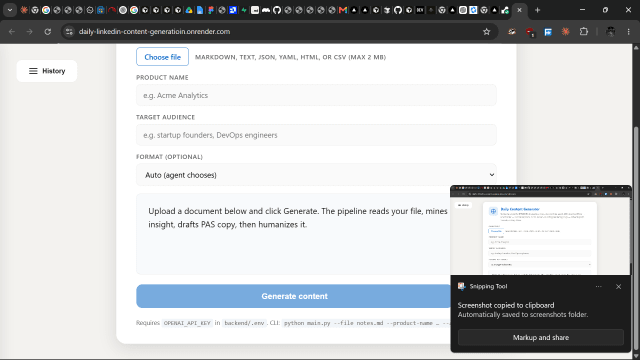
Daily Content Generator
Universal marketing content pipeline: upload a document (README, changelog, notes), run a three-agent Google ADK flow (Miner → Ghostwriter → Humanizer), and get human-sounding copy powered by OpenAI (via LiteLLM).
Built by Walter Onyango
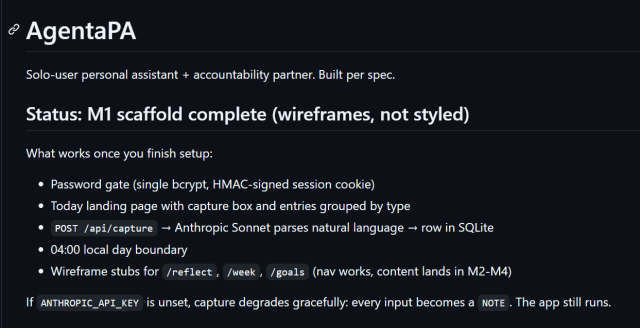

Agenta_PA
AgentaPA is a solo-user AI-powered personal assistant and accountability platform designed to turn messy thoughts into structured action. Users can naturally type tasks, reflections, reminders, or goals, and the system intelligently parses and organizes them using AI. The platform features secure password-based access, a smart “Today” dashboard, natural-language capture powered by Anthropic Sonnet, and productivity workflows built around daily reflection, weekly reviews, and goal tracking. It uses a custom 4 AM day-boundary system to better match real human routines rather than strict midnight resets. Built on a modern stack — Next.js 15, React 19, Tailwind v4, Prisma, and SQLite — AgentaPA is lightweight, private, and designed for deep personal focus. Even without AI keys configured, the system gracefully continues functioning as a structured note-taking and accountability tool. Current progress includes a fully functional M1 scaffold with authentication, session handling, AI capture parsing, entry management, and navigable wireframes for future modules like reflections, weekly analytics, and goals. The next milestone introduces persistent day logs, reflective insights, and progress visualization — moving toward a fully intelligent accountability companion.
Built by Agenta_PA Group

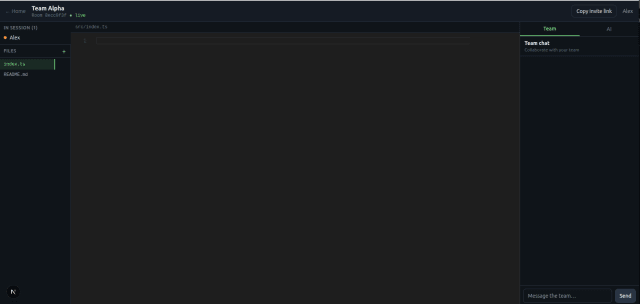
Cusor for Community
Cursor for Communities is a browser-based collaborative coding workspace designed for hackathons, bootcamps, and developer communities. It combines a real-time shared IDE, mentor collaboration, and an AI coding assistant that understands the actual project context instead of generating generic responses. The platform uses a modular monorepo architecture with a Next.js frontend and an Express + Socket.io backend. At its core is the Monaco Editor, powered by Yjs CRDT synchronization for safe real-time collaboration without overwriting concurrent edits. Teams can create rooms, edit code together, manage files, and see live participant presence with shared cursors and selections. Communication is split into two channels: team chat for human collaboration and a dedicated AI assistant panel. The AI assistant receives context from the active file, selected code, project structure, prior AI conversations, and optional error logs, enabling it to explain code, debug issues, and generate features grounded in the actual repository state. Each room supports lightweight mentor participation, allowing mentors to join live sessions, monitor code, and guide teams directly inside the workspace. Multiple rooms can run simultaneously, each maintaining isolated project state, collaboration sync, and chat history.
Built by C137

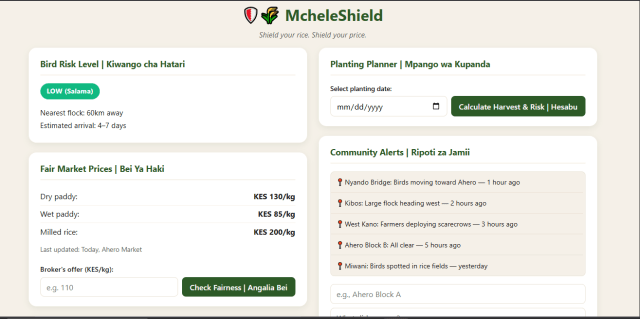
mchele shield
PROBLEM Quelea birds destroy 320kg/acre → KES 41,600 lost. Brokers pay KES 80 vs fair KES 130 → KES 64,000 stolen. Total: KES 105,600 per farmer per season. 600 farmers = KES 63M lost annually. No tool addresses both. McheleShield does. SOLUTION — 5 modules, one browser app, zero install: 1. Risk Dashboard — flock distance → risk tier (LOW/MEDIUM/HIGH/EXTREME) + Swahili alerts 2. Price Checker — broker offer vs KES 130 benchmark, shows exact loss per 100kg 3. Planting Planner — harvest date +120 days, flags peak migration months 4. Alert Feed — community bird sightings, prepend-only, WhatsApp-ready 5. Farmer Support — group buying + direct-to-buyer listings, no middlemen TECH Vanilla JS + Tailwind CDN. Zero build step. Deploys in 30 seconds. No React overhead. No localStorage. Sentry included for production error tracking. Built with Cursor Agent Mode — specification-first prompt, working code first run. IMPACT KES 105,600 protected per farmer per season. KES 63M protected across Ahero Irrigation Scheme annually. Phase 2: live quelea satellite API + Ahero price feed. Phase 3: WhatsApp two-way alerts — no browser needed. Birds or brokers. Farmer wins either way. [Open the app.]
Built by wesley wenceslaus


TerraNode
TerraNode — Project Description (Medium) TerraNode turns AI infrastructure’s land and water footprint into fundable, verified restoration — measured in square meters, not just carbon. AI data centers are spreading across farmland and thirsty watersheds, but most offset tools only track emissions. TerraNode closes that gap with a marketplace where AI operators can quantify their Arable Land Debt and fund real restoration projects — while the public micro-funds the same sites through a simple, mobile-first flow. Built as a MERN hackathon MVP (MongoDB, Express, React, Node), TerraNode delivers a production-style experience with simulated M-Pesa and corporate checkout: no real money moves, but the math, API, and database updates are real. Eight demo projects across Kenya — wetlands, forest buffers, dryland agriculture, urban greenbelts — show how abstract “compute debt” becomes visible land impact. The math (transparent, hackathon-grade) Land footprint — Racks = ⌈GPUs ÷ 8⌉. Each rack ≈ 12.5 m² of arable land; multiply by 2.3× for parking, power, cooling yards, and buffers. Water use — Annual liters = GPUs × hours/day × liters/GPU-hour (air 3.7, liquid 1.2, hybrid 2.4) × 365. Water → land — 1,000 liters/year ≈ 1 m² of irrigated-cropland equivalent. Total debt — Arable land debt (m²) = land footprint + water-equivalent land. Offset cost — $8.50 per m²; 1 restoration credit = 100 m² verified land. Example: 1,000 H100 GPUs, 22 hours/day, liquid cooling → ~3,594 m² physical land + ~9,636 m² water equivalent ≈ ~13,230 m² total debt → ~133 credits → ~$112,453 to fully offset. The UI uses a Regenerative Canvas design — editorial typography, sage and terracotta accents, golden-hour restoration imagery — so the story centers on land as the solution, not racks as the problem. Deploy-ready on Vercel with MongoDB Atlas. Carbon offsets the smoke. TerraNode offsets the soil.
Built by blue team


MissFit Tech
MissFit is a computer vision driven fashion infrastructure platform that extracts professional-grade 3D body measurements from just three 2D smartphone photos, utilizing a standard A4 piece of paper for mathematical scale. We built this to eliminate the guesswork of remote clothing fit, drastically reducing garment return rates for e-commerce brands and empowering independent African bespoke tailors to export custom garments globally. Using Cursor deeply accelerated our development cycle. It allowed us to rapidly prototype our UI, and seamlessly stitch our frontend to our computer vision backend.
Built by Immaculate Munde